
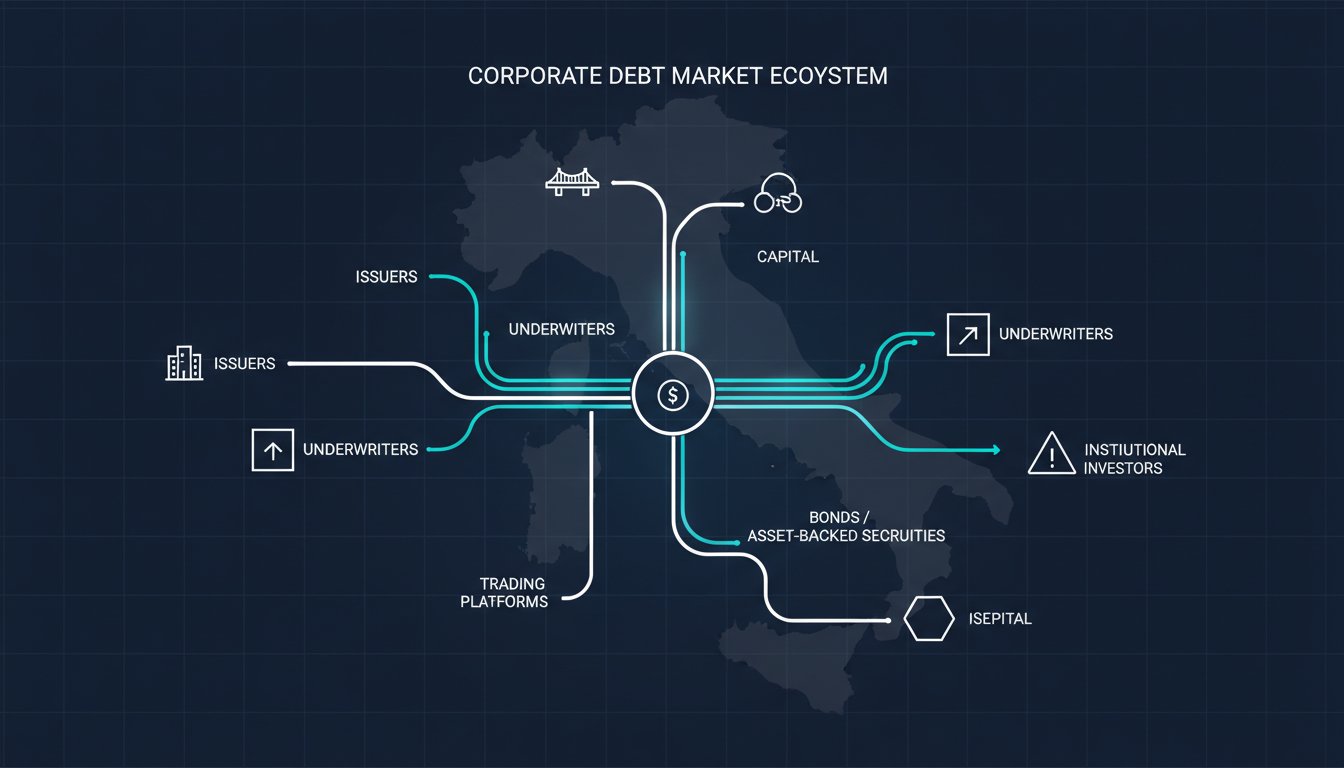
For institutional investors, navigating the intricate ecosystem of the corporate debt markets presents a persistent strategic challenge. The complexity of primary versus secondary market mechanics, the vast spectrum of available debt instruments, and the difficulty of assessing credit risk beyond standard ratings demand a superior analytical framework. Without a clear map, identifying high-value opportunities while mitigating risk is an inefficient, high-stakes endeavor.
This definitive guide is engineered to deliver that clarity. We deconstruct the market's fundamental architecture, providing a clear operational understanding of how debt is originated, issued, and traded. You will gain a systematic breakdown of key instruments-from investment-grade bonds and leveraged loans to bespoke private credit solutions-and learn to differentiate their unique risk/return profiles with precision.
Ultimately, this guide equips your institution with the intelligence to master the modern corporate debt landscape. By exploring advanced risk analysis and anticipating key technological and regulatory trends, you will be positioned to build a more resilient, high-performance portfolio and execute your investment strategy with absolute confidence.
Key Takeaways
- Master the dual-market structure to optimize capital deployment and identify liquidity opportunities.
- Move beyond generic bonds to effectively segment corporate debt by credit quality, security, and structure.
- Implement a robust due diligence framework that evaluates risk far beyond surface-level interest rates for superior asset selection.
- Understand the fundamental mechanics and emerging technological trends shaping the future of global corporate debt markets.
Table of Contents
- What Are Corporate Debt Markets? A Foundational Overview
- The Architecture of Corporate Debt: Primary vs. Secondary Markets
- Key Instruments and Segmentation in Corporate Debt
- Analyzing Corporate Debt: The Investor's Due Diligence Framework
- The Future of Corporate Debt: Technology, Regulation, and Market Trends
What Are Corporate Debt Markets? A Foundational Overview
The corporate debt markets represent a global, high-stakes ecosystem for the issuance and trading of debt securities by corporations. Its primary function is to provide an efficient mechanism for companies to raise capital by borrowing from institutional and individual investors. These debt instruments, most commonly corporate bonds, function as a loan to the issuing company. For a detailed primer on what is a corporate bond, these securities codify the issuer's obligation to pay interest (coupon) over a specified term and repay the principal amount at maturity. This framework stands in direct contrast to equity markets, where capital is raised by selling ownership stakes rather than by incurring debt.
For a detailed breakdown of the primary instruments within this market, review the following analysis:
The sheer scale of this market is immense, with the global value of outstanding corporate bonds measured in the tens of trillions of dollars. This vast liquidity and depth make it an essential asset class for institutional investors seeking predictable income streams and portfolio diversification. Its performance is a critical barometer of corporate health and broader economic sentiment.
The Core Function: Fueling Corporate Growth and Operations
Corporations leverage debt markets as a strategic tool to finance critical initiatives without diluting equity. Capital raised is deployed for a range of objectives, including large-scale capital expenditures, funding mergers and acquisitions (M&A), refinancing existing debt on more favorable terms, and managing day-to-day operational liquidity. As a key component of a company's capital structure, debt financing can optimize the weighted average cost of capital (WACC), directly impacting valuation and shareholder returns. A robust and accessible corporate debt market is therefore indispensable for economic dynamism, enabling innovation and expansion across all industries.
Key Participants and Their Roles in the Ecosystem
The corporate debt markets operate through a structured network of highly specialized participants, each performing a critical role:
- Issuers: These are the corporations seeking to raise capital. They range from blue-chip, investment-grade multinational corporations to high-yield growth companies across every sector of the economy.
- Investors: The primary capital providers are institutional investors, including pension funds, insurance companies, sovereign wealth funds, and asset managers who purchase debt securities to meet their investment mandates.
- Intermediaries: Investment banks are central to the ecosystem, acting as underwriters in the primary market to structure and sell new debt issues. In the secondary market, brokers and dealers facilitate the trading of existing securities.
- Regulators and Rating Agencies: Government bodies like the Securities and Exchange Commission (SEC) provide regulatory oversight. Independent credit rating agencies such as Moody's, S&P Global, and Fitch Ratings provide critical risk assessments that inform investment decisions.
The Architecture of Corporate Debt: Primary vs. Secondary Markets
Understanding the structure of corporate debt markets is fundamental to effective institutional investment. The market operates on a two-tiered architecture: the primary market, where debt is created, and the secondary market, where it is traded. This division is not merely procedural; it is the core engine that generates and sustains market liquidity.
Consider an analogy from real estate development. The primary market is the developer selling newly constructed properties for the first time. The secondary market is the subsequent resale of those properties between various owners. The initial sale establishes the asset, while the resale market provides its ongoing value and tradability.
The Primary Market: Where New Debt is Issued
This is the genesis of corporate debt. When a corporation requires capital, it issues new bonds directly to investors. The process is highly structured, beginning with a prospectus detailing the issuer's financial health and the bond's terms. Investment banks act as underwriters, pricing the issue and distributing it to institutional buyers through methods such as:
- Public Offerings: Broadly distributed issues registered with securities regulators.
- Private Placements: Direct sales to a select group of sophisticated investors.
The Secondary Market: Trading and Price Discovery
Once a bond is issued, it can be bought and sold among investors in the secondary market. This market is predominantly an over-the-counter (OTC) environment, facilitated by a network of broker-dealers. This constant trading activity is what makes the secondary market a powerful price discovery mechanism. A bond's market value is continuously updated based on supply, demand, credit risk, and macroeconomic factors, a key dynamic analyzed in reports on global corporate debt market trends.
Ultimately, the primary market would not function without the promise of liquidity provided by the secondary market. Investors are willing to purchase new issues because they have confidence in their ability to sell the asset later. This symbiotic relationship ensures a robust, efficient, and continuously valued ecosystem for corporate debt, empowering investors to manage portfolios with precision.
Key Instruments and Segmentation in Corporate Debt
Effective navigation of the corporate debt markets requires a granular understanding of the diverse instruments available beyond generic bonds. For institutional investors, segmenting this landscape by credit quality, security, and market accessibility is critical for strategic asset allocation. Each segment presents a distinct risk-return profile, enabling the construction of portfolios precisely aligned with investment mandates and risk tolerance.
Investment Grade vs. High-Yield Bonds
The primary segmentation in corporate debt is by credit quality. Investment-grade bonds, rated Baa3/BBB- or higher by agencies like Moody's and S&P, are issued by financially stable corporations. They offer lower yields in exchange for a higher probability of repayment. Conversely, high-yield (or "junk") bonds are issued by companies with lower credit ratings, offering higher yields to compensate investors for increased default risk. High-yield can provide alpha, while investment-grade debt offers stability and capital preservation.
Public Markets vs. Private Credit
Corporate debt can be accessed through public exchanges or private negotiations. Publicly traded bonds offer high liquidity and transparent pricing, though a deep understanding of corporate bond market mechanics is essential for optimal execution. In contrast, private credit involves direct lending to companies. This rapidly growing asset class is illiquid but offers a potential "illiquidity premium," higher yields, and more stringent investor protections (covenants) than are typically found in public markets.
Specialized Segments: Distressed and Convertible Debt
For sophisticated investors, specialized segments offer unique opportunities. Distressed debt involves purchasing the securities of companies in or near bankruptcy, a high-risk strategy predicated on a successful corporate turnaround. Convertible bonds function as hybrid instruments, offering the fixed-income characteristics of a bond with an embedded option to convert into a predetermined number of the issuer's equity shares, providing potential upside participation.
| Instrument Type | Typical Credit Quality | Yield Profile | Liquidity | Primary Risk |
|---|---|---|---|---|
| Investment Grade | High (BBB- or above) | Low to Moderate | High | Interest Rate Risk |
| High-Yield | Low (Below BBB-) | High | Moderate | Credit/Default Risk |
| Private Credit | Varies (Often Non-Rated) | High | Very Low | Illiquidity & Default Risk |
| Distressed Debt | Default / Near Default | Very High (Potential) | Low | Recovery Risk |
Analyzing Corporate Debt: The Investor's Due Diligence Framework
Successful capital allocation in the corporate debt markets demands a disciplined and multi-faceted due diligence framework. For institutional investors, evaluating a potential investment extends far beyond the stated coupon rate; it is a systematic process of quantifying risk to secure predictable returns. This analysis combines rigorous quantitative modeling with qualitative assessments of the issuer's strategic position and management integrity.
The Role and Limitations of Credit Rating Agencies
Credit rating agencies like S&P and Moody’s provide a foundational assessment of an issuer's creditworthiness, influencing market access and initial pricing. However, sophisticated investors recognize these ratings as a starting point, not a conclusion. Ratings can lag market developments, and the issuer-pays model presents potential conflicts of interest. True due diligence requires proprietary analysis that challenges and supplements agency-provided data.
Essential Metrics: Yield, Spread, and Duration
A robust analysis is built upon three core quantitative pillars. Yield-to-Maturity (YTM) calculates the total anticipated return if a bond is held until it matures. The Credit Spread measures the risk premium, representing the additional yield an investor receives over a risk-free benchmark rate (like a government bond) for taking on issuer-specific credit risk. Finally, Duration quantifies a bond's price sensitivity to changes in interest rates, serving as a primary metric for managing interest rate risk.
Identifying and Mitigating Core Risks
Effective due diligence is fundamentally an exercise in risk management. Institutional investors must identify, measure, and mitigate several primary risks inherent in the corporate debt markets:
- Credit Risk: The primary risk that the issuer will fail to make timely interest or principal payments, resulting in a default. Mitigation involves deep fundamental analysis of the issuer's financial health, industry position, and debt covenants.
- Interest Rate Risk: The risk that a rise in benchmark interest rates will cause the market value of a fixed-rate bond to decline. This risk is managed through duration analysis and portfolio hedging strategies.
- Liquidity Risk: The danger of being unable to sell a bond quickly at its fair market value. This is particularly relevant for less-traded issues from smaller companies or in stressed market conditions.
Executing this comprehensive framework requires access to superior data and analytical tools. The SIMI intelligent ecosystem is engineered to provide the high-caliber resources necessary for institutional-grade due diligence.
The Future of Corporate Debt: Technology, Regulation, and Market Trends
The landscape for institutional investors is undergoing a fundamental transformation. Key forces-technological innovation, a dynamic regulatory environment, and a paradigm shift in value assessment-are actively reshaping the corporate debt markets. Navigating this evolution requires a clear understanding of the trends that will define performance, risk, and opportunity in the years ahead.
The Rise of Digital Platforms and Marketplaces
Technology is systematically dismantling legacy inefficiencies in corporate debt. Digital platforms are disintermediating traditional market structures, creating a more direct and efficient ecosystem for institutional investors. These marketplaces enhance price discovery, streamline execution, and expand access to previously illiquid assets. For instance, platforms like the SIMINVEST Platform provide curated, secure access to private markets, empowering investors with superior data availability and transactional efficiency in a verified environment.
Impact of AI and Data Analytics on Credit Assessment
Artificial intelligence and advanced data analytics are revolutionizing the core function of credit assessment. By processing vast, unstructured datasets far beyond the scope of traditional models, AI-powered algorithms deliver a more nuanced and predictive view of risk. This technological leap enables:
- Accelerated Due Diligence: AI can analyze financial statements, news sentiment, and alternative data sources in minutes, not weeks.
- Enhanced Predictive Accuracy: Machine learning models identify subtle patterns and correlations that signal potential defaults or credit degradation.
- Superior Risk Identification: Algorithms can uncover hidden operational, supply chain, or governance risks that manual analysis might miss.
ESG Integration in Corporate Debt Investing
Non-financial factors are now central to sophisticated credit analysis. Investors increasingly recognize that Environmental, Social, and Governance (ESG) metrics are powerful indicators of a company's long-term viability and risk management capabilities. Strong ESG performance often correlates with operational excellence and a lower probability of default, making it an indispensable component of modern credit evaluation. This focus on sustainable value aligns directly with our company mission to build a resilient and responsible financial ecosystem. As this trend solidifies, ESG integration will become a standard, non-negotiable aspect of managing institutional portfolios in the corporate debt markets.
The Strategic Imperative: Mastering Corporate Debt
Successfully navigating the global corporate debt markets is a function of strategic insight and analytical rigor. As we've explored, a deep understanding of the primary and secondary market architecture, coupled with a forward-looking view on technological and regulatory trends, is fundamental. Ultimately, the ability to execute a meticulous due diligence framework is what separates leading institutional investors from the rest, allowing for the precise identification of high-value opportunities while mitigating inherent risks.
SimInvest provides the intelligent ecosystem to translate this strategic knowledge into superior performance. We offer institutional investors exclusive access to a curated pipeline of verified Italian private market assets. Leverage our proprietary AI-Powered Asset Analysis to uncover data-driven insights and execute your evaluation with absolute confidentiality inside our Secure Virtual Data Room. It is time to move from theory to execution. Access Curated Italian Private Market Opportunities on SIMINVEST.
Position your portfolio at the forefront of financial innovation.
Frequently Asked Questions
What is the difference between corporate bonds and corporate loans?
Corporate bonds are standardized, tradable debt securities issued to a broad investor base and sold on public markets. This structure provides liquidity and transparent pricing for institutional portfolios. In contrast, corporate loans are private, non-standardized credit agreements negotiated directly between a borrower and a lender or a small syndicate of lenders. Loans are illiquid and typically held to maturity, offering investors greater control over terms but limited secondary market exit options.
How does inflation and central bank policy affect the corporate debt market?
Inflation and central bank policy directly impact corporate debt markets through interest rate adjustments. When central banks raise benchmark rates to combat inflation, newly issued corporate bonds must offer higher yields to remain competitive. This causes the market value of existing, lower-yielding bonds to fall. This inverse relationship between interest rates and bond prices is a primary risk factor that institutional investors must model and manage within their fixed-income allocations.
What is the role of an underwriter in a new bond issuance?
An underwriter, typically an investment bank, serves as the critical intermediary in a new bond issuance. The underwriting syndicate purchases the entire bond issue from the corporation, assuming the risk of reselling it to institutional and retail investors. The underwriter’s primary functions include advising on the bond's structure and pricing, managing the regulatory process, and leveraging a vast distribution network to ensure a successful placement of the security in the market.
How liquid is the corporate debt market, particularly for high-yield or private debt?
Liquidity within the corporate debt market varies significantly by asset class. Investment-grade bonds from large, well-known issuers are highly liquid, with active secondary markets and tight bid-ask spreads. Conversely, high-yield (junk) bonds exhibit lower liquidity due to higher perceived credit risk and a more specialized investor base. Private debt is the least liquid, as these are bespoke loans with no public market for trading, requiring investors to hold to maturity or seek a negotiated private sale.
What are the main differences between the US and European corporate debt markets?
The primary distinctions are scale, currency, and market structure. The US market is substantially larger and more homogenous, dominated by USD-denominated issuances and a deep institutional investor base. The European market is more fragmented, with issuances in EUR, GBP, and other currencies, and has historically shown a greater reliance on bank-based financing. Disparate regulatory environments, such as SEC rules versus MiFID II, also create key operational differences for global investors.
What is a bond's 'covenant' and why is it important for investors?
A bond covenant is a legally binding term within the bond indenture between an issuer and its bondholders. These rules are designed to protect investor capital by restricting certain corporate actions. Negative covenants may limit a company's ability to issue more debt or sell critical assets. For institutional investors, strong covenants are a crucial risk mitigation tool, as they limit actions that could degrade the issuer's credit quality and impair its ability to service its debt obligations.