
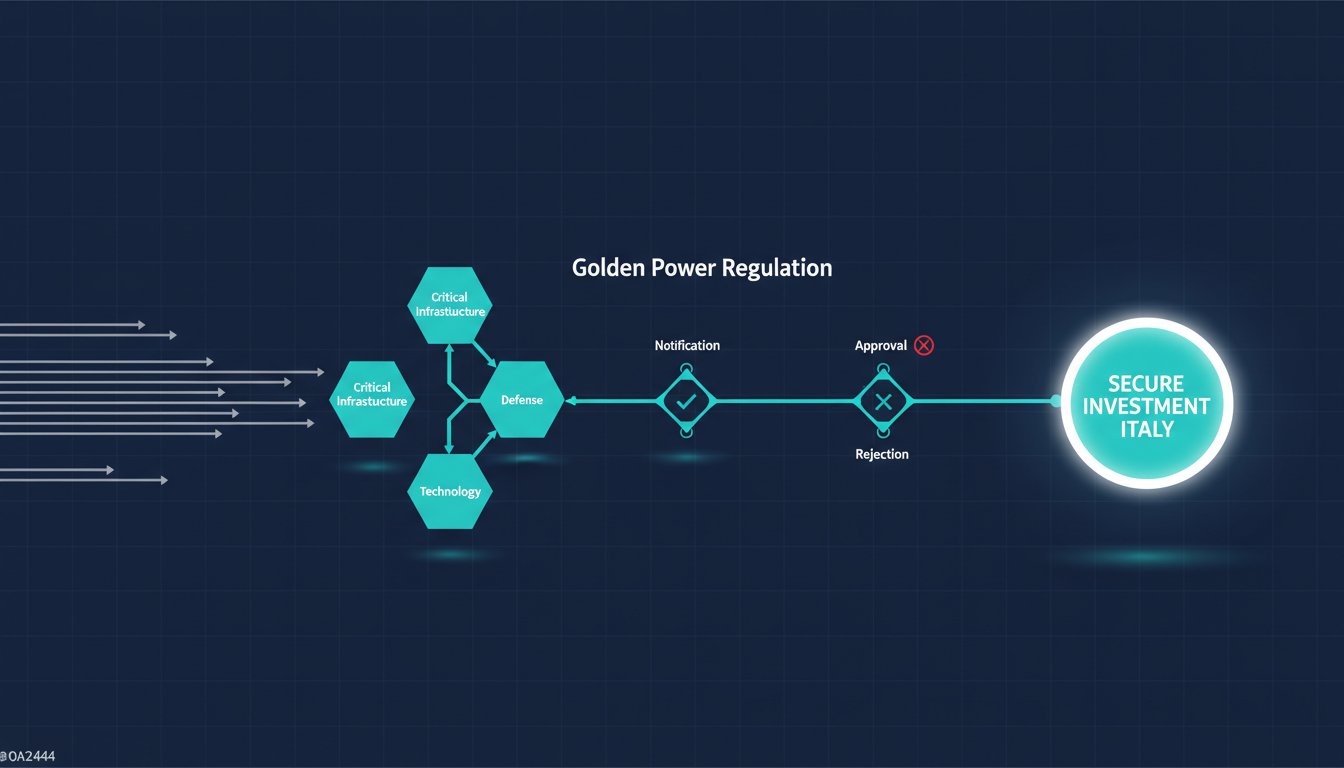
In the high-stakes ecosystem of Italian M&A, regulatory uncertainty is an unacceptable risk variable. The prospect of government vetoes, protracted deal delays, or severe non-compliance penalties can jeopardize significant institutional capital. This challenge is epitomized by the golden power Italy regulation, a complex and evolving framework governing foreign direct investment in strategic national sectors. For investors, the opacity of the notification process and the breadth of government discretion can undermine an otherwise robust investment thesis, creating critical friction in the transaction lifecycle.
This strategic guide is engineered to provide clarity and control. It delivers a definitive analysis of the regulation’s scope, identifies the specific triggers for mandatory notification, and outlines the precise compliance protocols for your transaction. By leveraging this intelligence, institutional investors can effectively mitigate regulatory risk, accelerate due diligence, and gain the confidence required to navigate the Italian M&A landscape with maximum efficiency and security.
Understanding the Golden Power: Core Principles and Objectives
For institutional investors targeting Italian markets, understanding the Golden Power is a non-negotiable prerequisite for successful asset acquisition. This mechanism is a strategic state power that grants the Italian government the authority to review, impose conditions on, or veto certain foreign direct investment (FDI) transactions. Its primary objective is the protection of national strategic assets and interests from external threats that could compromise Italy’s security, public order, or critical infrastructure.
For a concise overview of the mechanism's application and the EU perspective, review the following analysis:
The regulatory framework for golden power Italy has expanded significantly from its initial focus on defense and national security. Evolving from legacy Golden Share principles, its scope now encompasses a wide array of strategic sectors, including energy, telecommunications, 5G technology, finance, and healthcare. It is critical to distinguish this mechanism from standard antitrust or competition reviews; Golden Power is an instrument of national interest, not market regulation. Its assessment is based on potential threats to the nation, a fundamentally different calculus than market concentration analysis.
The Legal Framework
The legal architecture is anchored in Law Decree No. 21/2012, which has been systematically amended to broaden its reach in response to evolving geopolitical and economic landscapes. These expansions now cover sectors critical to the national economic ecosystem. All notifications and review processes are centralized and managed by a dedicated coordination group within the Prime Minister's Office, which holds the ultimate authority to impose prescriptive measures or veto transactions deemed prejudicial to national interests.
Who is Considered a 'Foreign Investor'?
The framework differentiates between investor origins, applying distinct levels of scrutiny to ensure a proportional response:
- Non-EU Entities: Subject to the most stringent notification requirements for acquisitions of controlling stakes in any designated strategic sector.
- EU Entities: Face a more targeted review, typically triggered only by transactions in the defense, security, energy, transport, and communications sectors.
A critical factor for institutional investors is the heightened scrutiny applied to transactions involving state-owned or state-controlled enterprises. Such entities are assessed for potential geopolitical influence, regardless of their origin.
Strategic Sectors Under Scrutiny: A Detailed Breakdown
The scope of golden power Italy is both extensive and dynamic, designed to protect national interests across a spectrum of strategic assets. For institutional investors, understanding this landscape is a critical component of pre-transaction due diligence. The framework is defined by a complex set of evolving FDI laws and regulations, which continuously adapt to geopolitical and technological shifts. Transactions involving target companies operating in these sectors trigger mandatory notification, initiating a government review process.
Data indicates that the telecommunications, energy, and high-technology sectors have been the most frequently reviewed industries in recent years, reflecting a clear focus on digital and energy sovereignty.
Defense, Energy, and Communications
This triad represents the traditional core of national security and forms the bedrock of the Golden Power framework. Institutional investments in these hard asset classes require meticulous evaluation.
- Defense & National Security: The law’s original focus, encompassing aerospace technology, military hardware manufacturing, and essential dual-use technologies.
- Energy: Pertains to critical infrastructure assets such as national electricity and gas transmission grids, LNG terminals, and strategic energy storage facilities.
- Communications: Targets the national digital backbone, including 5G network infrastructure, subsea communication cables, cloud technologies, and large-scale data centers.
Finance, Health, and Agri-Food
The regime has expanded significantly to safeguard societal resilience and essential services, impacting private equity and venture capital strategies in these verticals.
- Financial & Insurance: Protects systemic stability by monitoring acquisitions of market infrastructure operators (e.g., stock exchanges, clearing houses) and critical fintech platforms.
- Health & Biotech: A key area of focus, covering the production of pharmaceuticals, critical medical devices, and vaccine manufacturing capabilities.
- Agri-food: Ensures food security by overseeing assets within strategic supply chains, from primary production to logistics and distribution hubs.
High-Technology and Critical Inputs
This is the most rapidly evolving frontier for the golden power Italy regime, driven by technological sovereignty. Scrutiny extends to companies involved in:
- Advanced Digital Technologies: Artificial intelligence, robotics, semiconductors, cybersecurity, and quantum computing. A strategic asset could be a semiconductor design firm or a leading AI-powered data analytics company.
- Data Infrastructure: Cloud computing services and firms managing sensitive data, particularly for public administration or critical operators.
- Critical Inputs: Access to raw materials on the EU's critical list and advanced manufacturing capabilities essential for other strategic sectors.
The Notification Process: Triggers, Timelines, and Outcomes
Navigating the golden power Italy framework requires a precise understanding of its mandatory, pre-closing notification protocol. Investors must file a formal notification with the Presidency of the Council of Ministers before executing any qualifying transaction. This initiates a formal review period, typically lasting 45 business days, which can be extended. Crucially, a 'standstill obligation' applies during this phase, legally prohibiting the parties from closing the deal until a final decision is rendered. Failure to comply results in severe penalties, including nullification of the transaction and substantial financial fines.
Transaction Triggers for Notification
The obligation to notify is activated by specific transaction types involving strategic assets. Institutional investors must be prepared to file if the transaction involves:
- Acquisition of a controlling stake in a strategic Italian company by any non-EU entity.
- Acquisitions by EU entities, including those based in Italy, if the target company operates in the highly sensitive sectors of defense and national security.
- Acquisition of a minority stake by a non-EU entity that exceeds key thresholds, typically 10% of the share capital, with subsequent notifications required for exceeding 15%, 20%, 25%, and 50%.
- Corporate resolutions or acts, such as mergers, demergers, or the transfer of strategic assets, that could change the ownership, control, or availability of those assets.
Potential Government Interventions and Outcomes
Once the notification is filed and the review period commences, the Italian Government can exercise its special powers, leading to one of three primary outcomes. The decision is based on an assessment of potential threats to essential national interests. While a full veto is the most severe measure, it is not the most common. Analysis of 2023 Golden Power enforcement trends shows a significant increase in conditional approvals. The potential outcomes are:
- Unconditional Approval: The government clears the transaction to proceed as planned without any modifications.
- Conditional Approval: The transaction is approved subject to specific remedies. These may include commitments to maintain production levels, secure supply chains, or implement enhanced cybersecurity protocols.
- Veto: The government blocks the transaction entirely, deeming it an irreconcilable threat to national security or strategic interests.
Navigating the Review: Strategic Best Practices for Investors
Successfully navigating the golden power Italy review process requires a proactive and meticulously planned strategy. Institutional investors cannot treat the notification as a mere formality; it is a critical phase of the transaction lifecycle that demands strategic foresight. The primary objective is to de-risk the investment by anticipating and addressing potential government concerns before they escalate.
Engaging specialized legal counsel with a proven track record in Italian administrative and FDI law is a non-negotiable prerequisite. Furthermore, initiating early, informal communication with the reviewing authorities can provide invaluable insights into potential sensitivities, allowing for preemptive adjustments to the transaction structure or filing narrative.
Pre-Transaction Due Diligence
A robust due diligence process is the foundation of a successful Golden Power strategy. This initial phase must extend beyond financial metrics to include a thorough regulatory and political risk assessment. Key actions include:
- Asset Identification: Accurately determine if the target company, or any of its assets, operates within the strategic sectors defined by law.
- Climate Assessment: Analyze the current political sentiment and regulatory enforcement trends relevant to the specific industry and country of origin of the investor.
- Precedent Analysis: Review past Golden Power decisions on similar transactions to anticipate the government's likely position and potential remedies.
Access curated Italian assets on our secure platform.
Structuring the Transaction and Filing
The structure of the deal and the quality of the notification file are pivotal. A transparent, comprehensive, and strategically crafted submission can significantly accelerate the review process and mitigate the risk of intervention. Investors should focus on a filing that not only complies with regulations but also builds a compelling case for the transaction.
- Mitigate Risks: Consider transaction structures that ring-fence highly sensitive assets or technologies to isolate potential national security concerns.
- Articulate Benefits: Clearly detail the investment's positive impact on the Italian economy, including commitments to employment, R&D, and maintaining strategic supply chains.
- Prepare for Remedies: Proactively model and prepare for potential conditions or remedies the government might impose, ensuring they are commercially viable from the outset.
Enforcement Trends and Outlook for 2026
Analysis of recent government data reveals a clear trend: the application of golden power in Italy is both more frequent and more sophisticated. The volume of notified transactions has surged, driven by an expanded legislative scope and heightened geopolitical tensions. This has led to a more assertive stance in safeguarding national interests, particularly within strategic sectors like defense, energy, 5G telecommunications, and critical emerging technologies such as AI and quantum computing.
High-profile interventions have demonstrated the government's focus on supply chain security and technological sovereignty. Investors must now factor this heightened scrutiny into their due diligence and transaction timelines. The key takeaway is not that Italy is closing its doors, but that the entry requirements for strategic assets have become more rigorous and politically sensitive.
Key Takeaways from Recent Decisions
Recent enforcement actions provide a clear framework for investor expectations. The Italian government's approach is increasingly data-driven and focused on specific risk factors. Core trends include:
- Geopolitical Scrutiny: Heightened due diligence is consistently applied to acquisitions by entities from non-EU and non-NATO jurisdictions, particularly in sectors with dual-use technologies.
- Supply Chain Integrity: Interventions frequently target transactions that could compromise the integrity of strategic supply chains, from semiconductor manufacturing to essential pharmaceuticals.
- Preference for Remedies: The government shows a clear preference for imposing behavioral or structural remedies-such as commitments to maintain production in Italy or governance adjustments-over exercising its ultimate veto power.
Is Italy Still Open for Business?
The statistical reality confirms that Italy remains a premier destination for foreign direct investment. The vast majority of transactions notified under the golden power Italy framework are cleared unconditionally and efficiently. For sophisticated institutional investors, the process should be viewed not as a barrier, but as a predictable regulatory step in the acquisition lifecycle of a strategic national asset.
Italy’s strong industrial base, skilled workforce, and central position in key European value chains continue to present compelling opportunities. Navigating the regulatory landscape simply requires strategic foresight and access to premium, vetted assets. Find verified investment opportunities in Italy with SIMINVEST.
Navigating Italy's Golden Power: Your Strategic Advantage
The landscape for institutional investment in Italy is defined by strategic oversight. The key imperatives are clear: a comprehensive understanding of the regulation's core principles, proactive engagement with the notification process, and a forward-looking perspective on enforcement trends. Successfully navigating the complexities of golden power Italy requires more than legal compliance; it demands superior intelligence and transactional efficiency to secure high-value assets in strategic sectors.
Transform regulatory hurdles into investment opportunities with a platform engineered for institutional success. Leverage our AI-Powered Intelligence for accelerated preliminary due diligence, execute confidential transactions in a Secure Virtual Data Room, and explore a marketplace of curated assets. With the right ecosystem, you can operate with confidence and precision in the Italian market.
Join our network to access premium Italian investment opportunities.
Frequently Asked Questions
What are the penalties for failing to notify the Italian government?
Failure to notify triggers severe sanctions. The Italian government can impose administrative fines of up to twice the value of the transaction and no less than 1% of the parties' cumulative turnover. Critically, the government may also exercise its special powers to declare the transaction null and void, ordering the parties to restore the situation to its pre-transaction state. This represents a significant material risk for non-compliant institutional investors.
Does the Golden Power regulation apply to investments from EU-based entities?
Yes, the Golden Power regulation applies to EU-based entities. While the scope is broadest for non-EU investors, transactions by EU entities involving assets in sectors deemed critical-such as defense, national security, energy, transport, and communications-are subject to notification and review. The principle of free movement of capital is balanced against the state's imperative to protect its core strategic interests, making compliance mandatory for all investors operating in designated sectors.
How long does the Golden Power review process typically take?
The standard review process for golden power Italy notifications is 45 business days from the date of a complete filing. This period can be suspended once if the government requests additional information from the parties involved. For more complex cases or those involving defense and national security, the timeline may be extended. Investors must factor this statutory review period into their transaction closing timelines to mitigate potential delays and ensure a streamlined execution.
Can the government's decision to veto a transaction be appealed?
Yes, a government decision to exercise its special powers, including vetoing a transaction, can be appealed. The appeal must be filed with the Regional Administrative Tribunal of Lazio (TAR Lazio) in Rome within 60 days of the notification of the decision. This judicial review process provides a legal recourse for investors who believe the government's intervention is unfounded or disproportionate, though it introduces additional time and cost into the transaction lifecycle.
Does a change in corporate governance, without an equity transfer, trigger a notification?
Yes, a notification can be triggered without a direct equity transfer. The regulation covers not only acquisitions but also corporate resolutions or amendments to the articles of association that result in a change of control, governance, or the corporate purpose of a strategic asset. For institutional investors, this means that even internal reorganizations or changes to shareholder agreements could fall within the scope of the Golden Power rules and require a mandatory filing and assessment.
Are there any exemptions for small transactions or specific types of investors?
No, there are no general exemptions based on transaction size or investor type. The Golden Power framework is triggered by the strategic nature of the target asset, not a *de minimis* value threshold. Any transaction, regardless of its monetary value, that results in an investor acquiring a controlling stake or significant influence over a designated strategic company requires notification. The focus is exclusively on the potential impact on national strategic interests, not the scale of the investment.