
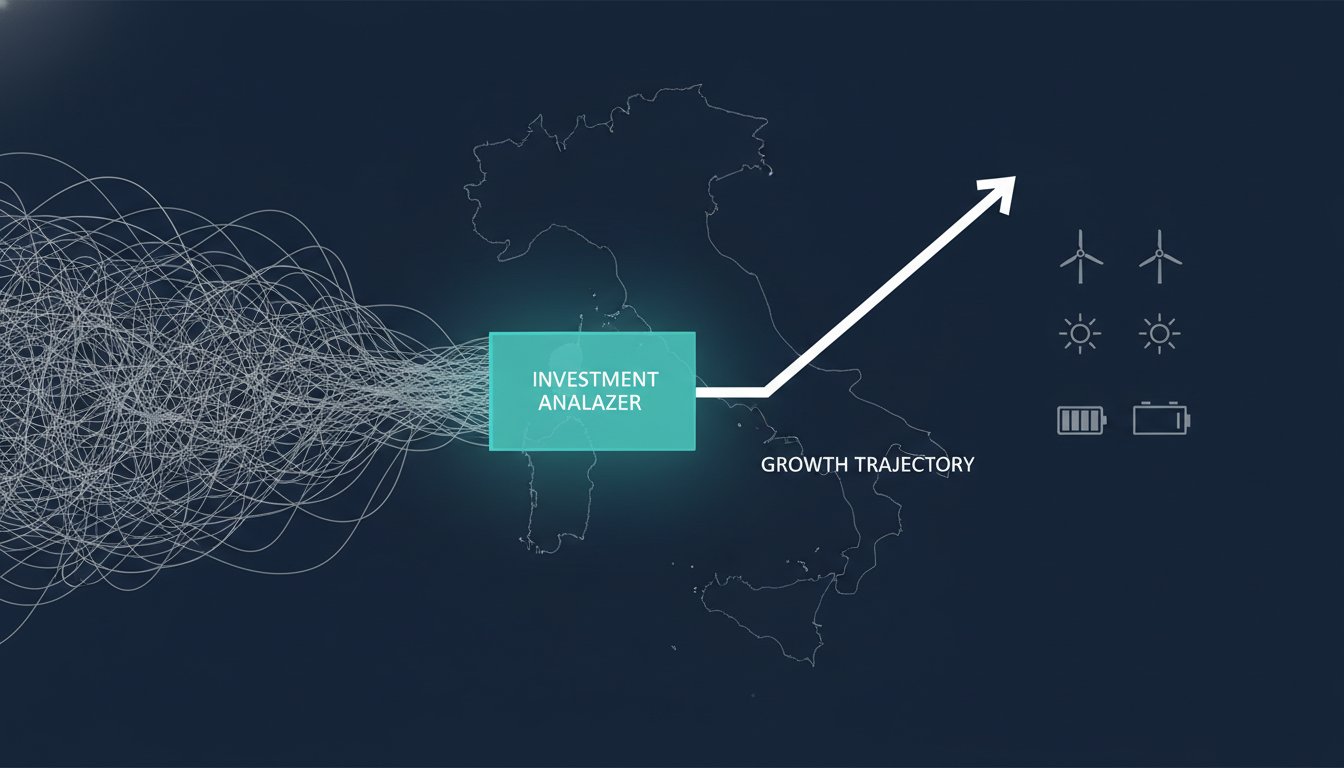
For institutional investors, the Italian renewable energy market presents a paradox: immense potential gated by opaque bureaucracy and fragmented market intelligence. Sourcing verified, high-quality deal flow is a persistent challenge, making efficient capital deployment into the Italy renewable energy investment landscape seem unattainable. This inefficiency creates a barrier that sophisticated investors can now overcome. This 2026 institutional guide provides the critical data and strategic framework required for successful market penetration.
We deliver a comprehensive analysis of the ecosystem, from key policy drivers and permitting pathways to the most lucrative sub-sectors like solar, wind, and energy storage. Gain the intelligence needed to de-risk your strategy, understand the specific market dynamics, and develop a clear investment thesis. This is your blueprint for accessing premium asset classes and executing high-value transactions within the Italian market, transforming complexity into a distinct competitive advantage.
The Strategic Imperative: Why Invest in Italian Renewables Now?
Italy has emerged as a critical nexus for European energy strategy, positioning itself at the forefront of the EU's decarbonization and energy independence mandates. For institutional investors, this alignment of policy, market demand, and technological need creates a compelling, time-sensitive opportunity. The confluence of ambitious national targets and unprecedented financial support mechanisms presents a clear signal: the window for high-value Italy renewable energy investment is now open.
The following analysis provides a high-level overview of the key market drivers.
Policy Frameworks Driving Growth: PNRR and REPowerEU
The Italian government's commitment is backed by substantial capital. The National Recovery and Resilience Plan (PNRR) allocates over €6 billion directly to renewable energy communities, agrivoltaics, and green hydrogen development. This is amplified by the REPowerEU plan, which is actively streamlining historically complex permitting processes-a critical de-risking factor for new projects. Italy's updated National Energy and Climate Plan (NECP) further solidifies this framework, creating a predictable and incentivized investment landscape with strong IRR potential.
Market Scale and Financial Projections to 2030
The scale of the required transformation is immense. To meet its 2030 targets, Italy must install approximately 70 GW of new renewable capacity, necessitating an estimated capital injection exceeding €100 billion. Building on its established history in Renewable energy in Italy, forecasts project exponential growth in solar PV and a significant ramp-up in both onshore and offshore wind, coinciding with a strategic phase-out of coal power. This massive capacity build-out is creating a robust market for corporate Power Purchase Agreements (PPAs) as industries seek to secure long-term green energy supply.
Critical Grid and Storage Infrastructure Development
Recognizing that generation is only one part of the equation, Italy is executing a multi-billion Euro grid modernization plan led by the national grid operator, Terna. This initiative focuses on enhancing transmission capacity and integrating renewables. Central to this strategy is the deployment of Battery Energy Storage Systems (BESS) to ensure grid stability. This creates discrete, high-potential investment opportunities in essential grid infrastructure and ancillary services, which are critical for the entire ecosystem's success.
Analysis of Core Renewable Sub-Sectors for Investment
A successful Italy renewable energy investment strategy requires a granular analysis of the distinct risk/return profiles across its core technology sub-sectors. While greenfield development offers higher potential returns, brownfield assets-particularly in onshore wind-provide stable, de-risked cash flows. Institutional capital must align deployment with specific asset class characteristics and geographic concentrations of opportunity.
Solar PV remains the dominant engine of Italy's renewable expansion. The primary opportunities are concentrated in utility-scale, ground-mounted projects, where high solar irradiance in southern regions like Sicily and Puglia offers superior generation efficiency. Concurrently, the decentralized Commercial & Industrial (C&I) rooftop market is expanding, driven by corporate demand for long-term Power Purchase Agreements (PPAs). A high-potential niche is emerging in Agrivoltaics (Agri-PV), which combines energy production with agricultural use, mitigating land-use conflicts and unlocking new revenue streams.
In the wind sector, the most immediate investment case lies in the repowering of aging onshore farms. Upgrading legacy turbines with modern, high-capacity technology offers significant efficiency gains and improved asset returns. The larger, long-term opportunity is Italy’s extensive and largely untapped offshore wind resource. While technically challenging, floating offshore technology is critical for the deep waters of the Mediterranean and represents a frontier for high-capex, high-return investment, with project auctions signaling accelerating market development.
Next-generation assets are essential for grid modernization. Battery Energy Storage Systems (BESS) are critical to mitigating the intermittency of solar and wind, creating opportunities in both co-located and standalone grid-scale projects designed for ancillary services. Further along the innovation curve, green hydrogen is positioned for exponential growth. The government's strategic focus is underscored by significant capital allocation within Italy’s recovery and resilience plan, creating early-stage investment opportunities across the production and infrastructure value chain.
Investment Profile Summary:
- Solar PV: Lower risk, stable returns. Strongest in utility-scale (South) and C&I.
- Onshore Wind: Mid-level risk. Dominated by brownfield repowering opportunities.
- Offshore Wind: High risk/return. Greenfield, capex-intensive, long-term potential.
- BESS & Hydrogen: High-growth, technology-driven. Early-stage with strong regulatory support.
Navigating the Italian Regulatory and Financial Landscape
Success in Italy renewable energy investment requires a granular understanding of its complex institutional framework. For institutional investors, mastering this landscape is a prerequisite for deploying capital effectively. Operations are primarily governed by three entities: the Ministry of the Environment and Energy Security (MASE) sets policy, the Gestore dei Servizi Energetici (GSE) manages incentives and auctions, and Terna operates the national transmission grid.
Deconstructing the Permitting and Authorization Maze
The primary pathway for project approval is the single authorization procedure (Autorizzazione Unica), a consolidated process intended to streamline approvals. However, securing the Environmental Impact Assessment (EIA) remains a critical and often lengthy bottleneck. Recent legislative simplification, particularly through the PNRR and Energy Decrees, aims to accelerate timelines by identifying "suitable areas" (Aree Idonee) where permitting is fast-tracked, reducing administrative friction for strategic projects.
Key Financial Mechanisms: Auctions, Tariffs, and PPAs
Revenue stability is typically secured through two primary channels. The GSE-managed auction system provides long-term revenue certainty via two-way Contracts for Difference (CfDs), insulating projects from wholesale market volatility. The government continues to support development through targeted programs, such as the recently approved State aid scheme for innovative renewables. Concurrently, the corporate Power Purchase Agreement (PPA) market is rapidly maturing, offering an alternative route to bankability, with pay-as-produced and virtual PPAs becoming standard structures.
Investor Risk Matrix: Identification and Mitigation
A rigorous due diligence process must account for several jurisdiction-specific risks. Effective mitigation strategies are essential for any significant Italy renewable energy investment. Key risk factors include:
- Regulatory Risk: Potential for retroactive policy changes, though recent frameworks have enhanced investor stability.
- Grid Connection & Curtailment: Delays in grid connection, particularly in Southern Italy and the islands, and the increasing risk of curtailment as renewable penetration grows.
- 'Golden Power' Rule: The government's right to review and block foreign investments in assets deemed strategic to the national interest, including energy infrastructure.
- Local Opposition: Proactive stakeholder and community engagement is non-negotiable to mitigate permitting challenges and ensure project viability.
For a detailed analysis of project-specific risks and opportunities, explore the curated asset marketplace at siminvest.it.
Executing an Investment: Sourcing and Diligence in the Italian Market
Transitioning from market analysis to capital deployment requires a sophisticated execution strategy. For institutional investors targeting the Italian renewables sector, success hinges on efficient deal sourcing, rigorous due diligence, and a clear entry model. In a competitive environment, gaining an advantage is not just about identifying opportunities-it is about processing them with superior speed and accuracy.
Investment Models: Greenfield vs. Brownfield Acquisitions
Foreign investors typically pursue two primary pathways. Greenfield development offers higher potential returns and the ability to control asset quality from inception, but it carries significant permitting and construction risks. Conversely, acquiring operational brownfield assets provides immediate cash flow and de-risked operations, making it a preferred strategy for portfolio consolidation. Partnering with established local developers can effectively mitigate greenfield risks, providing essential market access and navigating complex regulatory landscapes.
Leveraging AI for Accelerated Due Diligence
Technology is the engine of competitive advantage in modern finance. AI-powered platforms are essential for rapidly screening large portfolios of potential assets, automating the analysis of financial KPIs and ROI projections. This technological layer enhances traditional technical and legal due diligence by identifying anomalies and red flags in vast datasets. Ultimately, data-driven insights produce more accurate asset valuations, fortifying every Italy renewable energy investment decision with empirical evidence.
Accessing Verified Deal Flow via Private Marketplaces
Sourcing curated, off-market opportunities remains a significant challenge. Private marketplaces provide a secure and efficient ecosystem, connecting institutional buyers directly with verified sellers of infrastructure assets. These platforms offer a distinct advantage by centralizing deal flow and streamlining communication within a secure Virtual Data Room, ensuring absolute confidentiality during sensitive negotiations. This model transforms the sourcing process from a network-based activity to a data-driven, systematic function. Explore verified infrastructure assets on the SIMINVEST platform.
Execute Your Italian Renewable Energy Strategy with Precision
The Italian renewable energy landscape presents a strategic imperative for institutional investors, driven by robust policy support and significant growth potential across key sub-sectors. Capitalizing on this momentum demands sophisticated navigation of the nation's regulatory frameworks and a rigorous approach to asset sourcing and due diligence. A successful Italy renewable energy investment hinges on transforming these complex market dynamics into a clear, actionable advantage.
SimInvest provides the intelligent ecosystem to achieve this advantage. Our platform offers exclusive access to a curated pipeline of verified, institutional-grade opportunities. Streamline your diligence process with our AI-Powered Asset Intelligence and operate with complete confidentiality within our Secure Virtual Data Room with Dynamic Watermarking.
Request access to our marketplace to explore curated Italian renewable energy assets and position your portfolio at the forefront of Europe's energy transition.
Frequently Asked Questions: Investing in Italian Renewables
What are the typical expected returns (IRR) for renewable energy projects in Italy?
Expected Internal Rate of Return (IRR) for grid-parity solar and wind projects in Italy typically ranges from 7-9% on a leveraged equity basis. Projects with secured, long-term PPAs may command returns at the lower end of this spectrum due to reduced risk profiles. Unleveraged returns are generally projected in the 5-6% range. These figures position Italian renewables as a stable, high-value asset class for institutional investors seeking predictable, long-term cash flows in the European energy market.
How does Italy's 'Golden Power' regulation specifically impact foreign investment in the energy sector?
Italy's 'Golden Power' regulation grants the government special powers to review, condition, or veto foreign investments in strategic assets, including the energy sector. For non-EU investors, this introduces a layer of regulatory scrutiny over acquisitions of critical energy infrastructure. The process requires formal notification of transactions to the Prime Minister's office. A thorough due diligence process must therefore account for potential government intervention, which can impact transaction timelines and certainty of execution for foreign capital.
What are the most significant non-financial risks when investing in Italian renewables?
Beyond market volatility, the most significant non-financial risks involve permitting and grid connection. Italy's multi-layered authorization process can lead to significant project delays. Grid congestion, particularly in southern regions with high solar irradiation, presents a critical bottleneck for new utility-scale assets. Furthermore, navigating local stakeholder opposition requires a sophisticated engagement strategy. A dynamic regulatory landscape necessitates continuous monitoring to mitigate policy-related risks for any major Italy renewable energy investment.
How developed is the corporate Power Purchase Agreement (PPA) market in Italy?
The corporate Power Purchase Agreement (PPA) market in Italy is in a significant growth phase but is less mature than in other key European markets like Spain. While long-term PPAs (10+ years) are becoming more common, the market has historically been characterized by shorter-term offtake agreements. Increasing demand from large industrial and tech corporate offtakers is driving market development, enhancing the bankability of new projects and providing investors with stable, long-term revenue streams.
What is the average timeline for obtaining permits for a utility-scale solar project in Italy?
The average timeline for securing all necessary permits for a utility-scale solar project in Italy is approximately 24 to 36 months. This duration encompasses the complex Environmental Impact Assessment (VIA) procedure and obtaining the final single authorization (Autorizzazione Unica). While recent government decrees aim to streamline this framework, investors should factor this extended development cycle into their project models. Delays remain a primary risk factor affecting project delivery and final investment decisions.
Are there specific tax incentives for foreign capital investing in Italian green infrastructure?
While Italy does not offer tax incentives exclusively for foreign capital, general fiscal measures can benefit any Italy renewable energy investment. These include mechanisms like accelerated depreciation on capital expenditures for new machinery and equipment. The primary support structure is not tax-based but rather consists of long-term revenue contracts awarded through competitive auctions. Furthermore, funding allocated through the National Recovery and Resilience Plan (NRRP) provides substantial support for green infrastructure development.